Buying guide · Evidence checked 2026-08-29
AI Voice API Buying Guide: Cost, Rights and Production Fit
A practical, evidence-led decision guide. Product capabilities and limits are separated from anything that would require hands-on testing.
An AI voice API becomes infrastructure the moment customers hear it. A bad purchase does not merely waste a subscription: it creates latency, pronunciation repairs, consent risk and a bill that grows every time audio is regenerated. This guide narrows the market by operating model, then shows how to buy one named model and voice—not a vendor logo.
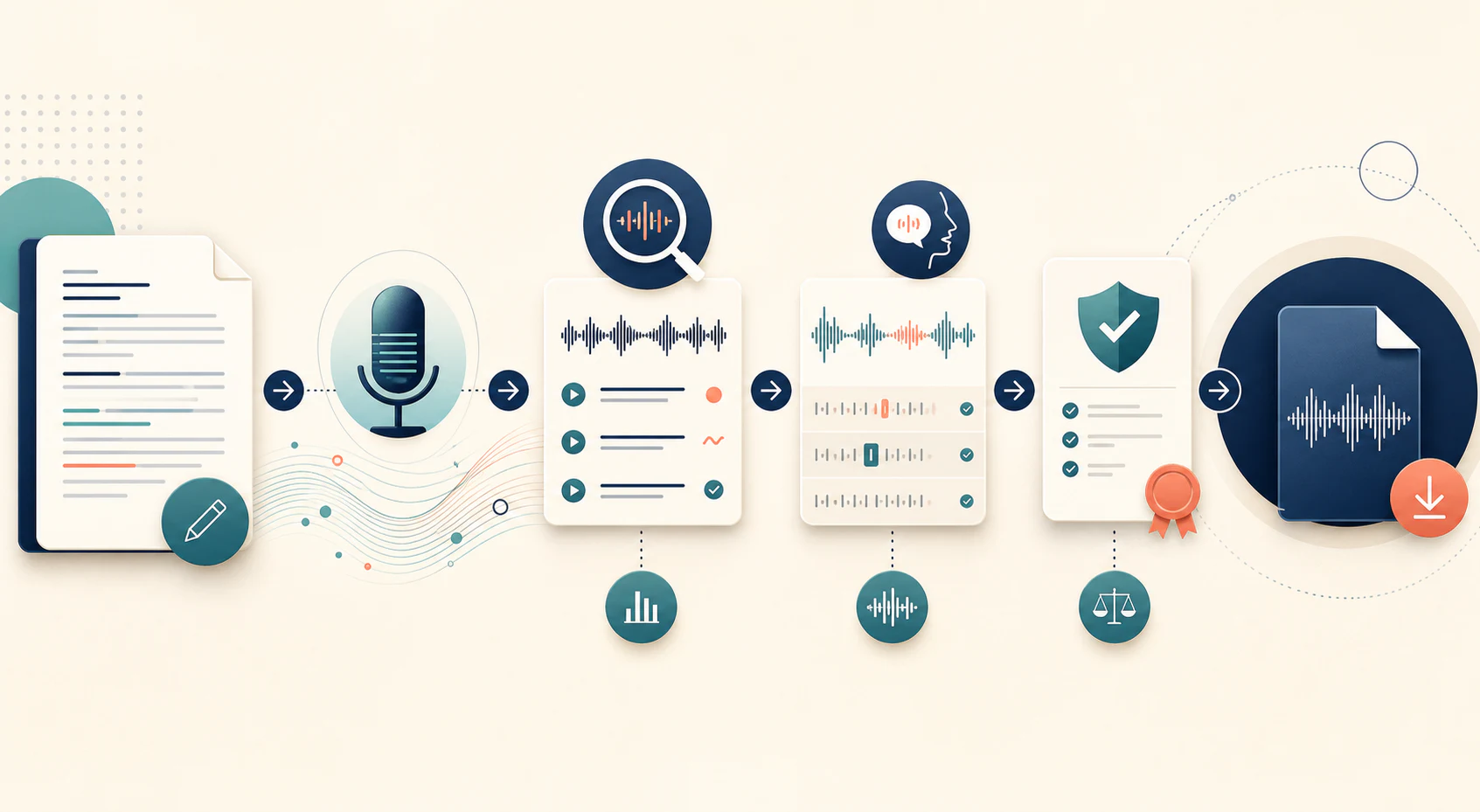
First choose the operating model
The shortlist becomes manageable once the production job is clear:
- Cloud-native batch/application speech: Amazon Polly, Azure AI Speech and Google Cloud Text-to-Speech fit teams already governed inside their respective clouds.
- Conversational agents: Deepgram Aura and Cartesia Sonic focus more tightly on streaming, short turns and developer-controlled interaction.
- General programmable audio stack: OpenAI Audio may fit applications already using OpenAI models and APIs.
- Expressive or custom voice path: evaluate the exact eligibility, consent and model terms rather than assuming every vendor offers the same cloning route.
Do not ask one procurement exercise to choose an IVR voice, a 10-hour audiobook and a branded custom voice. They have different latency, correction and rights gates.
A shortlist that reflects the architecture
| Production job | Start with | Why it belongs | Do not proceed until… |
|---|---|---|---|
| Batch speech inside AWS | Amazon Polly | Published engine pricing, AWS-native controls and a direct cloud route | The selected voice/engine exists in the deployment region |
| Speech inside a Microsoft estate | Azure AI Speech | Standard, personal and restricted custom-voice paths plus enterprise deployment choices | Regional meters and custom-voice eligibility are confirmed |
| Speech inside Google Cloud | Google Cloud Text-to-Speech | Multiple voice families, API formats and cloud integration | The exact model price and allowance are attached to the workload |
| Low-latency conversational turns | Deepgram Aura or Cartesia Sonic | Streaming-oriented products with developer-controlled interaction | Request size, concurrency, latency and fallback behavior pass at p95 |
| Audio in an existing OpenAI stack | OpenAI Audio | One programmable route alongside other OpenAI services | Model, token economics, disclosure and voice policy fit the product |
This table chooses the first test, not the final winner. A cloud-native service can be operationally cheaper even when another API has a more persuasive demo voice, because identity, billing, monitoring and regional controls already exist in the buyer's environment.
Write a production contract before opening accounts
Name the deliverable, monthly and peak volume, languages, maximum request size, latency target, audio format, deployment regions and owner of listening approval. List hard failures: unsupported language/region, unconfirmed commercial rights, no required deletion path, inability to repair a protected name or peak concurrency below the application load.
For agents, define time-to-first-audio at p95 and cancellation behaviour. For batch work, define throughput, chunk continuity and accepted finished minutes. A generic “high-quality voice” requirement is not testable.
Eliminate candidates on paper
Verify the exact voice/model/region combination and request limits before a listening test. Deepgram Aura's documented 2,000-character request ceiling may be fine for turns and wrong for chapters. OpenAI's speech endpoint documents an input limit. Polly voices and engines vary by region. Azure custom-voice paths may require eligibility and access approval. Google model choice changes pricing and allowance.
Remove any candidate that fails a hard requirement. Do not spend trial time proving that an architectural mismatch still sounds good.
Model the bill with regeneration included
Keep native meters separate. Polly publishes $4/$16/$30/$100 per million characters across Standard, Neural, Generative and Long-Form engines. Azure can add custom-voice training, hosting or storage meters. Google pricing is model-specific. Cartesia combines subscription, credits and concurrency. OpenAI audio pricing depends on the chosen model/token route. Deepgram needs the current Aura commercial rate attached to submitted characters.
Use:
`billable units = new units + defect regeneration + editorial-change regeneration`
`workflow cost = synthesis + required plan/add-ons + hosting/egress + reviewer and repair labour`
Calculate normal and launch months. A 25% planning allowance is useful before observations exist, but replace it with the actual correction distribution after the pilot. Never turn a consumption multiplier into a price multiplier without normalising plan price, allowance, unit and output.
A concrete character-cost example
For five million billable characters, the retained Amazon Polly rates produce these synthesis-only scenarios:
| Polly engine | Published rate per million characters | Five-million-character subtotal |
|---|---|---|
| Standard | $4 | $20 |
| Neural | $16 | $80 |
| Generative | $30 | $150 |
| Long-Form | $100 | $500 |
The table does not say Standard is five times “better value” than Long-Form, or that another vendor is more expensive. It shows what one documented meter does at one volume. Add free allowances where eligible, regeneration, storage/egress and the staff time needed to produce accepted audio. Compare another provider only after converting its own model and meter on the same workload.
Run two tests, not one
The audio fixture should contain names, numbers, abbreviations, dates, currency, deliberate pauses and the longest realistic passage. Blind two listeners and record observable defects.
The operational fixture should run the expected chunk size and concurrency, include cancellation/retry and introduce a late name or figure correction. Record first-audio p50/p95, completion, errors, retries, submitted units, repair actions and final accepted minutes.
Preserve raw requests, configuration and audio. A vendor demo, a single warm request or an edited final file cannot support the purchase.
Treat consent and data as product features
Ask which records are required for custom or personal voices, who can create and delete them, what request text/audio is retained, whether data is used for model improvement, what changes by region and which actions appear in audit logs. Verify commercial output rights for the exact plan and use case, including client work or embedding.
If the public documentation does not establish a material term, record it as an open procurement question. “Probably covered by enterprise” is not evidence.
Make reliability and exit part of the purchase
For customer-facing speech, define the behavior when the preferred model is slow, unavailable or removed. A fallback voice can protect uptime while damaging brand consistency or pronunciation. Test the fallback rather than merely configuring it.
Retain source text, pronunciation rules, model/voice identifiers, generation settings and the accepted output. Confirm rate-limit responses, retry guidance and whether an idempotency strategy is possible for the integration. A blind retry can create duplicate cost or two inconsistent audio files.
The exit plan should answer three questions: can the application change provider without rewriting its content model, can approved pronunciations be exported, and can the team reproduce the latest accepted files after account closure? If those answers are no, migration cost belongs in the purchase decision.
Compare correction paths
A voice that wins the first listen can lose in production if names are expensive to repair. Test lexicons, SSML, IPA or instruction controls supported by the exact model. Change a number after approval and measure whether a segment can be regenerated without damaging timing or context.
The useful metric is not defects per sample alone. It is stable accepted corrections per human action and cost per accepted minute after rework.
Final decision record
| Gate | Candidate A | Candidate B | Owner |
|---|---|---|---|
| Exact model/voice/region eligible | Engineering | ||
| Rights/consent/data passed | Legal/security | ||
| Required language and controls | Product | ||
| First-audio p95 / throughput | Engineering | ||
| Critical defects and stable repairs | Editorial/QA | ||
| Normal and peak workflow cost | Finance | ||
| Exit/fallback route | Product | ||
| Remaining unknown | Decision owner |
Approve a configuration only when every hard gate passes and the remaining unknown is explicitly accepted. Stop comparing when another candidate tests no different operating model; extra demos create motion, not evidence.
Choose the next test now
Use the Amazon Polly buying analysis when AWS integration and transparent engine rates fit the architecture. Use the Azure AI Speech analysis when deployment, identity and custom-voice governance sit inside Microsoft. Compare Deepgram Aura with Cartesia Sonic when first-audio latency and cancellation behavior are the deciding constraints.
Do not open six trial accounts. Select the two operating models that can satisfy the production contract, run the same audio and operational fixtures, and keep the cheaper accepted result—not the cheapest first response.
Official sources used for examples
- Amazon Polly engine pricing ↗ — checked 2026-08-26.
- AWS Amazon Polly developer overview ↗ — checked 2026-08-26.
- Amazon Polly features and controls ↗ — checked 2026-08-26.
- Microsoft Azure AI Speech text-to-speech overview ↗ — checked 2026-08-26.
- Microsoft Azure AI Speech documentation index ↗ — checked 2026-08-26.
- Azure Speech Services pricing and meters ↗ — checked 2026-08-26.
- Google Cloud Text-to-Speech overview ↗ — checked 2026-08-26.
- Google Cloud Text-to-Speech model pricing ↗ — checked 2026-08-26.
- Google Cloud Text-to-Speech API documentation ↗ — checked 2026-08-26.
- OpenAI Audio speech API reference ↗ — checked 2026-08-26.
- OpenAI text-to-speech guide ↗ — checked 2026-08-26.
- OpenAI API model pricing ↗ — checked 2026-08-26.
- Deepgram Aura models and languages ↗ — checked 2026-08-26.
- Deepgram text-to-speech request guide ↗ — checked 2026-08-26.
- Deepgram Aura-2 voice controls ↗ — checked 2026-08-26.
- Cartesia plan, credit and concurrency pricing ↗ — checked 2026-08-26.
- Cartesia Sonic platform overview ↗ — checked 2026-08-26.
- Cartesia TTS endpoint comparison ↗ — checked 2026-08-26.