Comparison · Evidence checked 2026-08-29
Cartesia Sonic vs Deepgram Aura: Which Workflow Fits Better?
A practical, evidence-led decision guide. Product capabilities and limits are separated from anything that would require hands-on testing.
Cartesia Sonic and Deepgram Aura are bought for the same demanding moment: a user is waiting while an agent speaks. That makes endpoint behaviour, chunking, concurrency and pronunciation repair more important than a long voice list. Cartesia exposes a credit-and-plan ladder with several streaming transports; Deepgram Aura documents a tightly scoped agent/IVR path and a 2,000-character request ceiling. The winner is the service that survives your turn-taking loop without hiding its true unit cost.
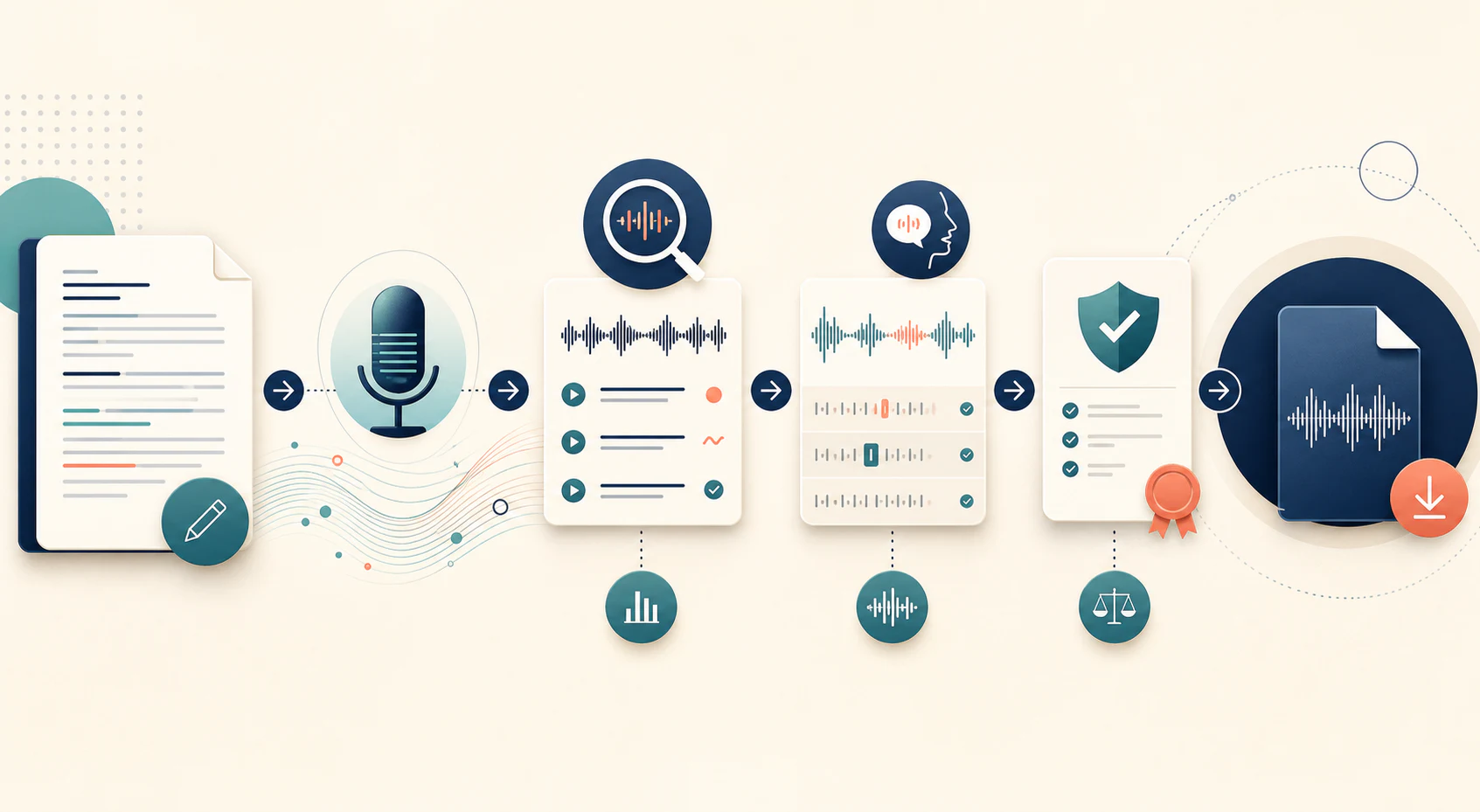
Pick the agent path before the voice
Trial Cartesia Sonic first when WebSocket/SSE choices, plan concurrency and cloning options are central to the product design. Trial Deepgram Aura first when a compact agent or IVR stack, Aura-2 language coverage and IPA pronunciation control fit the job. Do not buy either from a latency claim alone: measure time to first playable audio under your own network, chunk sizes and concurrent turns.
The differences an agent team will feel
| Decision point | Cartesia Sonic | Deepgram Aura |
|---|---|---|
| Primary job | streaming speech for conversational agents and real-time products | low-latency speech for agents, IVR and other developer-controlled applications |
| Published price boundary | The official page lists Free at USD 0, Pro at USD 5, Startup at USD 49 and Scale at USD 299 per month, with credits and concurrency varying by tier. | The retained official documentation establishes model and request limits, but the exact current per-character rate remains an account/pricing-page check before purchase. |
| Poor fit | a buyer whose priority is a conventional audiobook or course-production workspace | a creator who needs a long-form project editor and production library |
| Main unknown | credits must be translated into the buyer's real minutes and model | Aura requests are limited to 2,000 input characters |
| Evidence | Official sources; no hands-on verdict | Official sources; no hands-on verdict |
Neither column proves production latency or voice quality. Those are observed properties of a named model, configuration and network path.
Cartesia gives the transport layer more choices
Cartesia's byte streaming, SSE and WebSocket options let an engineering team choose how tightly synthesis is coupled to the agent loop. Its public plan ladder—Free, Pro at $5, Startup at $49 and Scale at $299 per month—also gives a clear entry path for prototyping and growth. Voice cloning availability by plan may matter when the voice itself is part of the product.
The hard part is translating plan credits into the exact model usage and concurrency the application will consume. A low subscription is not evidence of a low cost per completed conversation. Model-version controls and limits must be captured with the request, or a benchmark can silently compare different capabilities.
Aura keeps the short-turn problem tightly scoped
Aura's case is narrower and easier to explain: REST/streaming synthesis for agents and IVR, Aura-2 coverage across seven documented languages, plus speed and IPA pronunciation controls where supported. For short conversational turns, the 2,000-character input ceiling can be a useful design constraint rather than a practical obstacle.
It becomes a poor fit when the same endpoint is expected to produce long chapters or when the application assumes Flux and Aura share languages, formats or endpoint behaviour. Deepgram's current per-character rate must also be confirmed from the live commercial surface before the cost case is complete.
Why plan price cannot answer cost per conversation
Cartesia Sonic: The official page lists Free at USD 0, Pro at USD 5, Startup at USD 49 and Scale at USD 299 per month, with credits and concurrency varying by tier.
Deepgram Aura: The retained official documentation establishes model and request limits, but the exact current per-character rate remains an account/pricing-page check before purchase.
For each service, record characters submitted, characters retried, credits consumed, successful turns and abandoned turns. Then calculate:
`monthly synthesis cost ÷ accepted conversations`
Keep concurrency failures in the denominator problem: a cheap request that arrives too late or must be retried is not an accepted turn. Cartesia's subscription should be paired with its included credits and overage behaviour for the selected model. Deepgram's calculation should use the current Aura rate and actual submitted characters, including regenerated chunks. Until both are known, the result is “cost unresolved,” not a guessed price comparison.
A trial built around interruption, not narration
Prepare 30 short agent replies: greetings, numbers, URLs, three proper names, one long response near the Deepgram request ceiling and five cases where the user interrupts. Use the same text and equivalent audio format.
Measure time from request dispatch to first playable audio, time to completion, cancellation behaviour, bytes received after cancellation, retry count and pronunciation defects. Run once at single concurrency, then at the expected peak. Averages alone hide agent failures, so retain p50, p95 and worst-case time to first audio.
For the repair round, change one proper name and one speaking-speed instruction. Record whether Cartesia's chosen model and Deepgram Aura-2 expose a controlled fix, how much audio is regenerated and whether the correction survives ten repeated turns. This is more informative than a blind “naturalness” vote because it tests the work that follows a defect.
Production gates specific to conversational audio
- Confirm whether cloned-voice creation is available on the intended plan and what consent record is required.
- Set a timeout and fallback response for synthesis failure; silence is not an acceptable error state.
- Separate agent-model latency from TTS latency in logs.
- Pin the exact TTS model/version rather than accepting an unrecorded default.
- Verify concurrency and rate-limit recovery at peak traffic.
- Decide what request text and generated audio may be retained in application logs.
Which one deserves the latency test first?
Cartesia is the more flexible prototyping choice when transport options, plan concurrency and voice cloning shape the product. Aura is the cleaner first candidate for a short-turn agent/IVR workflow that benefits from its documented language and pronunciation controls. Neither earns the deployment from documentation: the purchase should follow a peak-concurrency interruption test and a reconciled cost per accepted conversation.
Give the first integration to the tighter fit
Open the Cartesia Sonic analysis when transport choice, plan concurrency and cloning are part of the product design. Open the Deepgram Aura analysis when the application is built around short agent turns and Aura-2's documented language and pronunciation controls.
Integrate only the first candidate that matches the architecture, then force interruptions, retries and the longest real reply at peak concurrency. Bring in the second only if the first misses a named gate. A second polished voice demo is not evidence; a lower p95 with controlled cancellation and a reconciled cost per accepted conversation is.
Agent-build questions that affect the shortlist
Does Deepgram's 2,000-character ceiling rule it out?
Not for most agent turns. It matters when the application sends long monologues or fails to chunk safely. Test the longest real response, not an average one.
Is Cartesia's $5 Pro plan automatically cheaper?
No. Subscription price, credits, model usage, concurrency and overage must be translated into accepted conversations before comparing it with per-character billing.
What single metric matters most for an agent?
Time to first playable audio at p95 is a strong starting point, but pair it with interruption waste, errors and pronunciation-repair effort. A fast first byte can still produce an expensive conversation.
Official sources
- Cartesia plan pricing and credits ↗ — checked 2026-08-26.
- Cartesia platform overview ↗ — checked 2026-08-26.
- Cartesia TTS endpoint comparison ↗ — checked 2026-08-26.
- Deepgram Aura models and language coverage ↗ — checked 2026-08-26.
- Deepgram text-to-speech getting started ↗ — checked 2026-08-26.
- Deepgram Aura-2 voice controls ↗ — checked 2026-08-26.